
Quick FactsOverview
About Big Bend Hot Springs
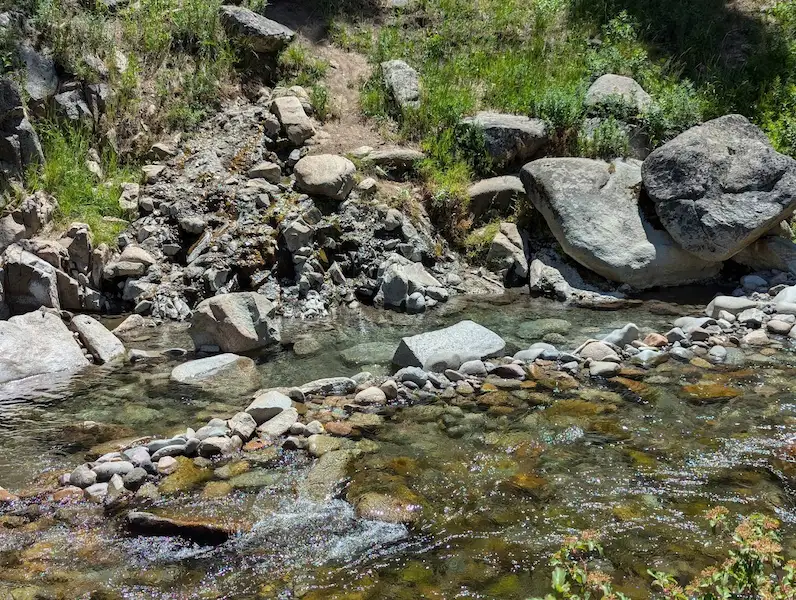
Big Bend Hot Springs, Texas is a natural geothermal spring inside Big Bend National Park in the Chihuahuan Desert of West Texas, set within the stone foundation ruins of a bathhouse built in 1910 along the Rio Grande on the US-Mexico border. The spring flows at approximately 105 degrees Fahrenheit year-round.
The site forms part of the Hot Springs Historic District, listed on the National Register of Historic Places. Homesteader J.O. Langford began developing the springs in 1909 after hearing of them while visiting Alpine, Texas. He built a bathhouse, a store and post office, and a motor court. The property passed to the state of Texas in 1942 and eventually became part of Big Bend National Park. The store ruins, motor court, and bathhouse foundation all remain along the trail, alongside ancient pictographs on the limestone cliffs that document human use of the area over many centuries.
These natural hot springs in Texas are among the most historically layered in the country. The spring pools within the stone bathhouse walls beside the flowing Rio Grande, with the Sierra del Carmen range rising in Mexico directly across the water. Entry is included with standard Big Bend National Park admission, and no separate reservation or additional fee is required to soak once inside the park.
Location & Access
Getting to Big Bend Hot Springs
Big Bend Hot Springs is reached via a short hike of approximately 0.3 miles along a flat trail from the Hot Springs Trailhead, accessed by a 1.6-mile narrow gravel road called Hot Springs Road. The turn onto Hot Springs Road is approximately 17 miles southeast of Park Headquarters at Panther Junction, off the paved road toward Rio Grande Village.
The gravel access road is narrow and suited to passenger cars and standard SUVs only. Dual-wheeled vehicles, motorhomes, and trailers should not attempt it and can park at a wider area further back, adding about a mile each way to the walk. The trail itself runs flat alongside the Rio Grande with minimal elevation change. Vault toilets are available at the trailhead, but there is no potable water, so visitors must carry their own supply.
Big Bend National Park is very remote, and reaching it requires significant driving. From Marathon, the nearest town outside the park for visitors looking for hot springs near Marathon, the north park entrance is approximately 40 miles south via US-385, then another 20 miles to the Hot Springs Road turnoff. The nearest airports are in Midland and El Paso, each several hours away by road. There is no public transportation to or within the park. Cell service is absent in most of Big Bend, including at the Hot Springs, so downloading offline maps before entering is essential.
Suitability & Accessibility
Who Big Bend Hot Springs Is Suitable For
Big Bend Hot Springs suits visitors of most ages who are comfortable with a short, flat desert hike and are prepared for a remote, primitive outdoor environment. The trail from the parking area to the spring is under a third of a mile with minimal elevation change, making it manageable for most able-bodied visitors including families with older children.
The site is not wheelchair accessible. The gravel access road is unpaved, the trail surface is uneven in places, and there is no accessible infrastructure at the spring. Young children require close supervision near the water, which flows at approximately 105 degrees Fahrenheit and is significantly hotter than a conventional hot tub.
Those looking for natural hot springs in Texas without developed facilities will find Big Bend Hot Springs is the most notable option within the national park system in the state. The experience is entirely outdoors and primitive: a stone-walled pool fed by a geothermal spring, open to the sky, beside the Rio Grande with Mexico visible across the water. There are no changing rooms, no showers, no lockers, and no food or drink at the spring. Visitors with heat sensitivity should approach the hottest areas with caution. The cooler months from October through April are more comfortable given extreme summer heat in the Chihuahuan Desert. Planning the visit for early morning in any season reduces sun exposure during the hike.
Safety & Etiquette
Safety and Etiquette at Big Bend Hot Springs
Big Bend Hot Springs is in a remote area with significant natural hazards that require serious advance preparation. There is no lifeguard, no cell service, and no medical facility within the park. The spring flows at approximately 105 degrees Fahrenheit, hot enough to cause burns on prolonged contact. Visitors should test the water before entering and limit soak time, especially in warm weather when desert heat and hot spring soaking together can cause rapid dehydration.
The Rio Grande runs alongside the spring and can rise unexpectedly after rainfall upstream. When river levels are high, water may enter the soaking area and make conditions unsafe. Checking conditions with park rangers before hiking out is advisable after any rain. Entering the Rio Grande itself is hazardous due to strong currents. The US-Mexico border runs along the river at this point, and crossing into Mexico without using the official Boquillas border crossing within the park is not permitted.
Visitors must carry significantly more water than they expect to need. The NPS recommends at least one liter per person per hour of planned activity in this climate. Sunscreen, a hat, and sun-protective clothing are practical necessities. Food and snacks should be packed before arriving, as the nearest services are at Rio Grande Village several miles away.
Leave No Trace principles apply throughout the park. Glass containers are not permitted at the spring. Pets are not allowed on any trails in Big Bend National Park, including the Hot Springs Trail. The pictographs on the cliff walls along the trail are protected cultural resources and must not be touched. Camping at the spring is not permitted, and overnight backcountry use requires a permit from a park visitor center.