
Quick FactsOverview
About Huckleberry Hot Springs
Huckleberry Hot Springs, Wyoming is a geothermal spring on Polecat Creek in the John D. Rockefeller Jr. Memorial Parkway, near Flagg Ranch in Teton County between Grand Teton National Park and Yellowstone National Park. Soaking in the spring is prohibited by NPS regulation, has been enforced since 2014, and the water has been found to contain dangerous pathogens. Do not enter the water. The trail to view the springs remains open for hiking.
The NPS began enforcing the existing prohibition against entering geothermal features in 2014, citing resource damage including trampled vegetation, worn rocks, changed water composition, and formation of social trails. In 2016, NPS water monitoring detected E. coli in excess of EPA limits and naegleria fowleri, a single-celled organism that causes primary amebic meningoencephalitis, an almost always fatal brain infection. The same monitoring also detected these pathogens at nearby Polecat Springs. The trail to view Huckleberry Hot Springs is approximately 0.6 miles one-way from the trailhead near Grassy Lake Road, with 36 feet of elevation gain. The spring site is within the John D. Rockefeller Jr. Memorial Parkway, administered by Grand Teton National Park, and a park entry fee applies.
Location & Access
Getting to Huckleberry Hot Springs
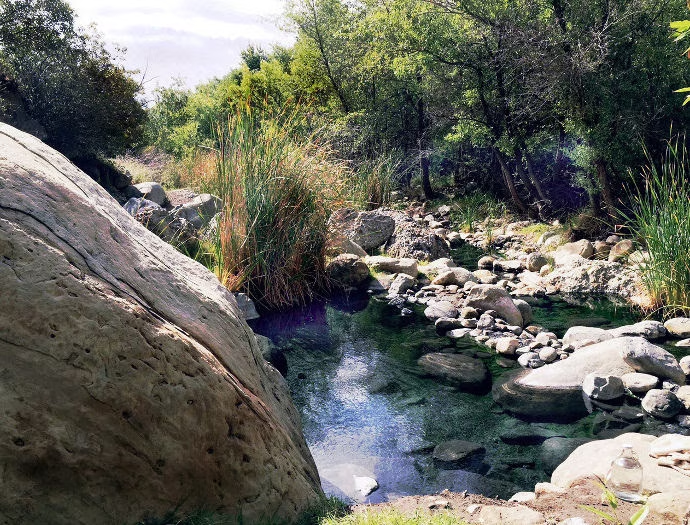
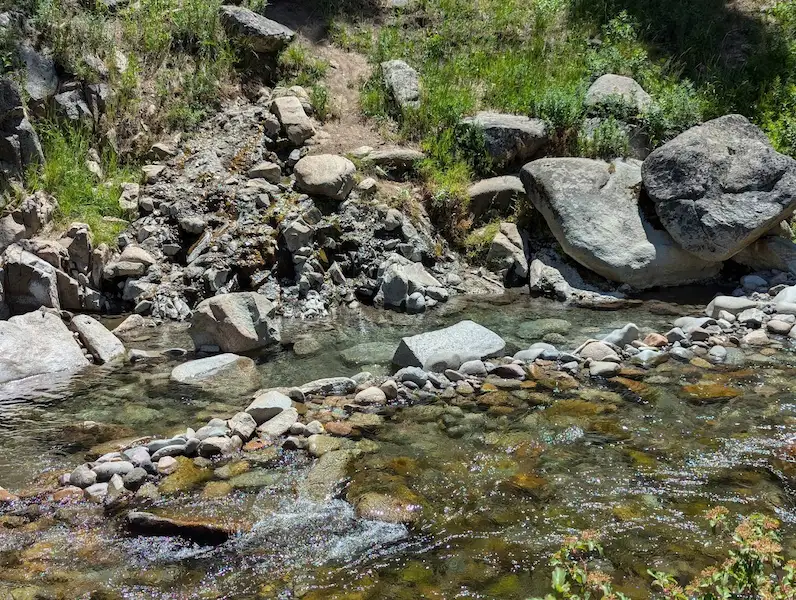
Huckleberry Hot Springs is reached by a short trail of approximately 0.6 miles one-way from a trailhead on Grassy Lake Road, located approximately 1 mile west of the Flagg Ranch Visitor Center. From the Flagg Ranch complex, head west on Grassy Lake Road for approximately 1 mile. The trailhead is on the right side of the road immediately after crossing Polecat Creek. The trail is easy with minimal elevation gain and follows a well-maintained gravel path through partially burned and old-growth forest to a meadow where the hot springs emerge from the ground along Polecat Creek.
The trailhead is accessible by any vehicle when the park road is open. The park road in this area is closed during the winter months; access in winter is limited. The John D. Rockefeller Jr. Memorial Parkway is administered by Grand Teton National Park and a park entry fee applies. Cell service is inconsistent in the Flagg Ranch corridor; download maps before arriving. For those seeking natural hot springs near Flagg Ranch Wyoming, Huckleberry is the closest geothermal feature to the Flagg Ranch area, though entry into the water is prohibited. Visitors who want to soak in the region should consider Astoria Hot Springs or Granite Hot Springs, both approximately 90 to 100 miles south near Jackson.
Suitability & Accessibility
Suitability of Huckleberry Hot Springs for Visitors
Huckleberry Hot Springs is suitable only as a viewing destination. Soaking in the geothermal features is prohibited by NPS regulation and enforced with fines. Additionally, the water has been found to contain E. coli exceeding EPA limits and naegleria fowleri, which causes an almost always fatal brain infection. These conditions make water entry genuinely dangerous, entirely apart from the legal prohibition. Do not enter the water under any circumstances.
The hiking trail to the springs is easy and suitable for most visitors. The 0.6-mile one-way route on a well-maintained gravel path has only 36 feet of elevation gain. The trail involves a ford of Polecat Creek, which can be as high as mid-thigh in spring. In summer and fall when water levels are lower, the crossing is easier. The surrounding forest and meadow area is scenic, and the springs are visually distinctive. Nearby Polecat Hot Springs, fed by the same geothermal system, can be viewed along the same trail.
The site is not wheelchair accessible due to the creek crossing and soft terrain near the springs. Families may visit with children for the hiking and viewing experience. For those seeking natural hot springs near Flagg Ranch Wyoming with a viewing-only intent, the short easy trail makes this an accessible addition to a Flagg Ranch or Rockefeller Parkway itinerary. No facilities are on site at the springs.
Safety & Etiquette
Huckleberry Hot Springs Safety Information
Do not enter Huckleberry Hot Springs or any geothermal feature in the John D. Rockefeller Jr. Memorial Parkway. Soaking is prohibited by NPS regulation since 2014 and violators face fines. Water monitoring has detected E. coli exceeding EPA limits and naegleria fowleri in the spring water. Naegleria fowleri causes primary amebic meningoencephalitis, a nearly always fatal brain infection contracted when contaminated water enters the nasal cavity. Do not swim, wade, or allow spring water near your nose or mouth. These hazards are not seasonal. They apply regardless of weather, water temperature, or apparent conditions at the site.
The trail involves a Polecat Creek crossing that can run high and fast in spring and early summer. Test depth before crossing and turn back if the water is above knee height or moving strongly. Waterproof footwear is recommended. Ground near the springs can be soft and unstable. Stay on the established trail to protect vegetation and footing.
Bears, moose, and other wildlife are present throughout the parkway. Carry bear spray and make noise on the trail. Cell service is limited near Flagg Ranch. Download offline navigation before arriving. The park road in this area is closed in winter. The Flagg Ranch Visitor Center is approximately 1 mile east of the trailhead.
Do not touch any geothermal feature, pool, or outflow in the Grand Teton and Rockefeller Parkway area. Polecat Creek, which receives geothermal inflow and mixes with cold water, remains technically open to recreation. The creek temperature varies by section and season.

%252C%2520Wyoming%25201.avif)